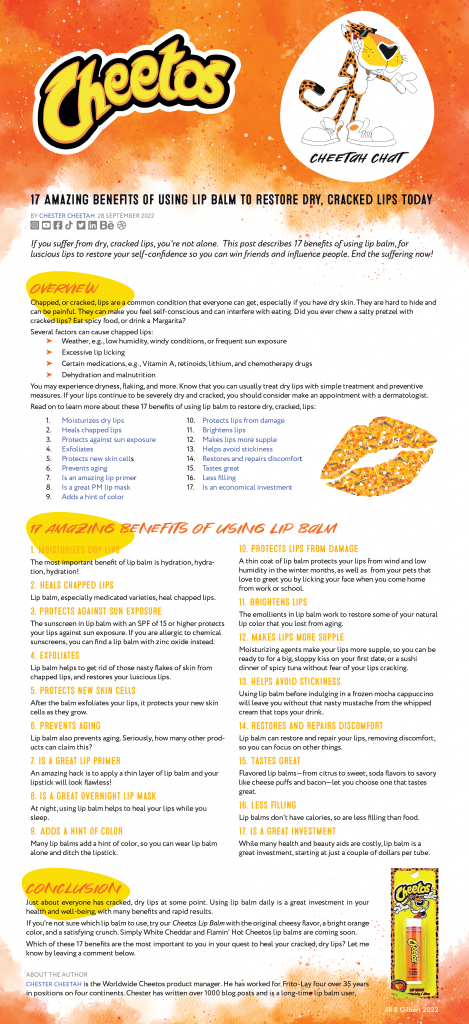
You’re probably wondering why I am interested in lip balm. Since I live in Houston, I need it when the humidity drops below 70% or if I have spicy food for lunch and wipe my lips too often. But seriously… my challenge was to create two marketing pieces for Cheetos Lip Balm. Cheetos introduced the lip balm in 2005—I am not making this up—and it was a marketing flop. Today, I think that marketing such a product could be a success because of the prevalence of social media marketing channels. After all, pickle- and bacon-flavored lip balms are available, as well as dozens of other sweet, spicy, and savory flavors of lip balm.
You can see my Cheetos Lip Balm blog post below. It’s a bit tongue-in-cheek in places (pun intended). Enjoy!
The top three graphic design deliverables my clients request are new or updated brands, brand guidelines, and custom presentation templates.
PowerPoint has been around for more than 35 years. It still rules the roost as the leading slide presentation tool, despite the emergence of tools like Google Slides, Keynote, ZOHO Show, Canva, and Prezi. Organizations large, mid-sized and small use it to communicate all sorts of messages–sometimes well done, and other times not so well done.
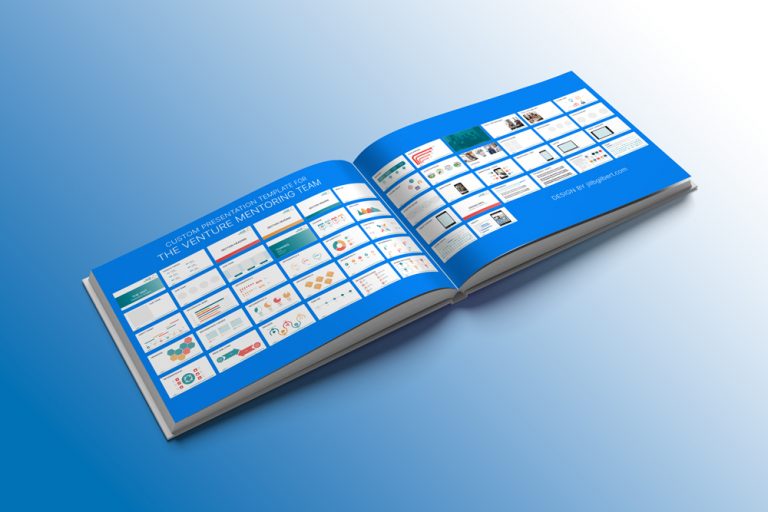
With hundreds of free and paid templates available, many of my clients request custom, branded slide templates. Why? Because custom templates do a better job of communicating your brand.
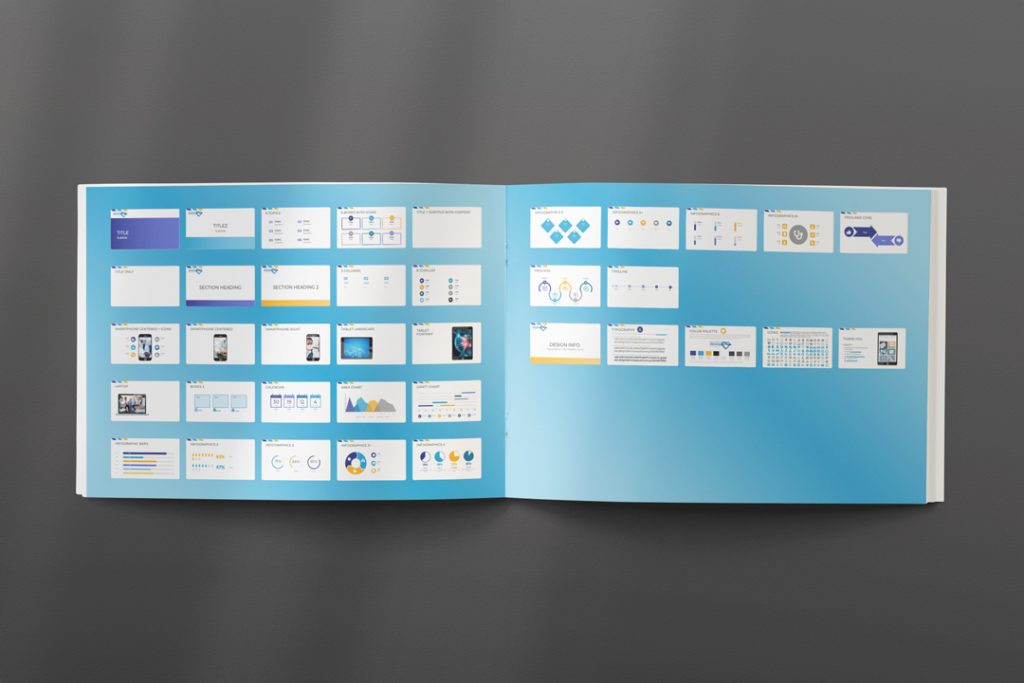
The Venture Mentoring Team | Custom, branded slide deck
Showcase your brand and ditch boring bullet slides
A custom template allows you to showcase your brand. Your brand is more than a logo; it is your company’s personality. Your brand is how others perceive, interact with, and build trust in your company.
Your organization’s personality really shines when you ditch a deck of boring “bullet” slides for a mix of text and graphics. Use a custom template to consistently communicate your brand. See the template above, created for The Venture Mentoring Team. This template fits the organization’s mission, vision, and values, and takes advantage of their logo style and colors. It is a complete package that truly changes how they can communicate from now on.
The Venture Mentoring Team Logo
Primo presentation pointers
Use the template throughout your organization for a consistent message.
Provide guidance on usage of your logo, color palette, typefaces, and fonts (bold, italics, regular, etc.).
Find a style that works for your organization, whether playful or serious, bold or subdued, geometric, minimal or corporate.
Use a single style for graphics and illustrations; don’t use cheap clip art with a first-rate template.
Provide a variety of infographics, photo, and text layouts for different purposes.
Make it easy for others to use the template, providing instructions and training as needed.
If online presentation tools don’t meet your needs, if you want more than the built-in templates that come with your software, or have trouble finding a template you like, then a custom template may be for you.
I have designed dozens (hundreds?) of templates for PowerPoint, Google Slides, and Keynote (for Mac users). If you need a custom, branded presentation template and don’t have the know-how to do it yourself, then consult a pro!
The Wisconsin Association of Free & Charitable Clinics (WAFCC) is an advocate for the State’s ninety free & charitable clinics. The organization provides state advocacy, education opportunities, consulting services, and telehealth services to clinics. WAFCC fosters collaboration, networking, and resource-sharing. They selected Jill B Gilbert for two branding initiatives–brand guidelines and a custom presentation template consistent with these new guidelines.
Brand Guidelines
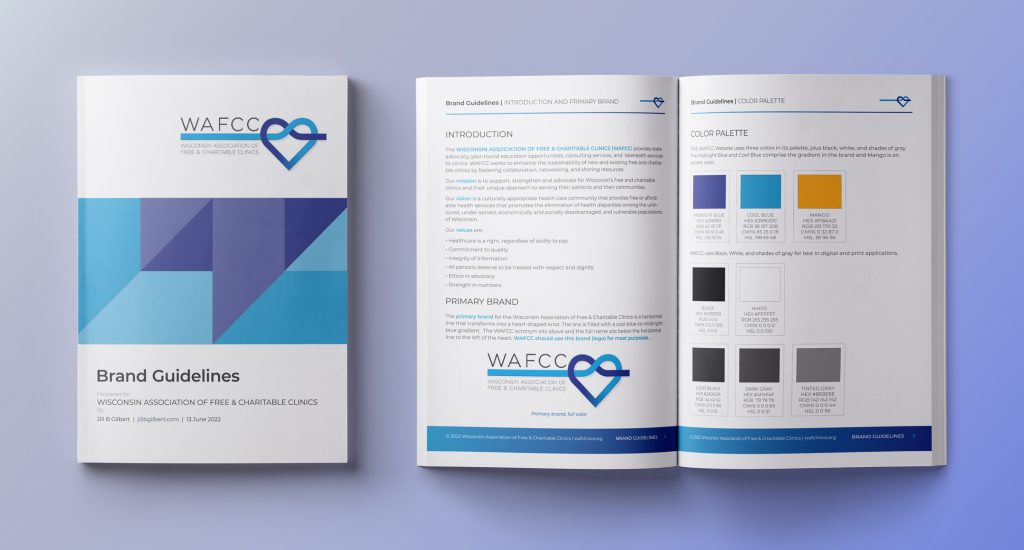
Brand guidelines are the rules an organization–large or small–follows to ensure their brand is consistent across various digital and print communications. These guidelines typically communicate the organization’s voice, style, logo, type, and colors.
They show the accepted use of the logo, any color variations, and placement, including very important “Do’s and Don’ts.” If an organization uses specific graphic styles, icons, or illustrations, the guidelines contain these, too.
Brand Guidelines are meant to be flexible, changing as the organization grows and changes. The WAFCC Brand Guidelines are a living document, soon to be updated with examples from the new slide presentation template.
Brand Guidelines | Wisconsin Association of Free & Charitable Clinics
"I HIGHLY RECOMMEND ANYONE TO WORK WITH JILL. SHE HAS A WEALTH OF KNOWLEDGE, IS VERY KIND, RESPONSIVE, AND DID A WONDERFUL JOB ON OUR VISUAL BRAND GUIDE."
Heather Ule
WAFCC
Presentation Template
The most common methods of communication are email, PowerPoint (/Google Slides/Keynote/Other) presentations, and social media.
Branding is important in slide presentations, because it sets the tone for your organization’s message. Consistent style and message are key!
Jill B Gilbert designed a template that was a great match for WAFCC’s message and style needs.
"This was my second project with WAFCC. I enjoyed working with Heather and building a relationship. We plan to work together on more projects in the future."
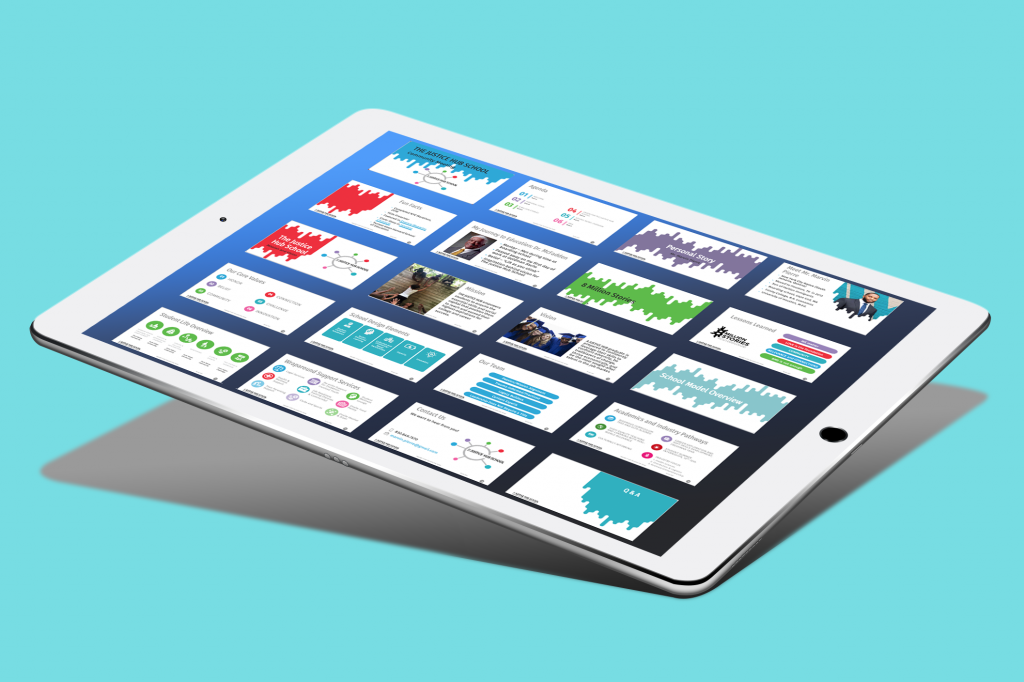
Custom slide template and presentation for The Justice Hub School
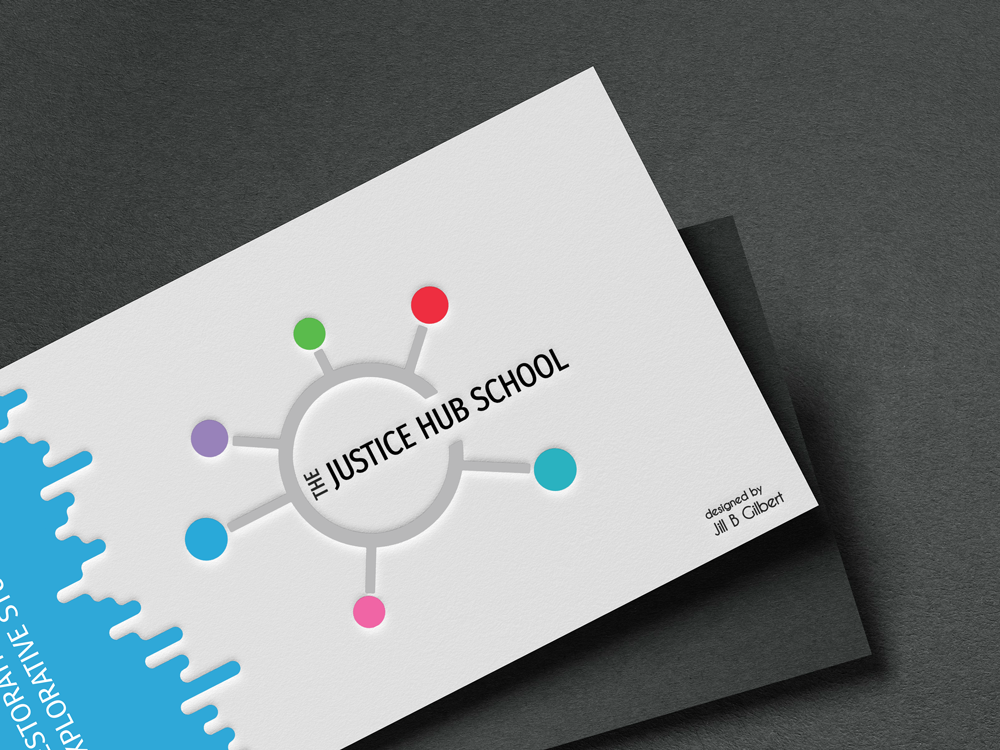
The Justice Hub School provides underserved youth in Houston’s Third Ward with academic and leadership skills to succeed in life. Jill B Gilbert was pleased to create a colorful new brand and a stylish custom presentation templates for this public charter school.
Our graphic design team created two templates aimed at different audiences–prospective donors and board members, and prospective students. Both templates employ Justice Hub’s new brand and color scheme. The image above shows the second, less formal, template on an iPad Pro.
I have a client that needs graphic design work for multiple brands, and wants all of their brands in a single portfolio. Their services generally target the same audience, and the audience can choose one or more services; these services do not compete with one another. My client seeks consistency in the way they portray the different services in digital and print media.
If your organization manages more than one brand, you have different options to manage them. Your branding strategy–key to your marketing strategy–depends on your target audience and customers.
Whether you already have several brands, or you anticipate new product or service lines, you can find a structure that works for your organization.
Individual Brands or Parent and Sub-Brands
Two options for managing multiple brands are:
a multi-brand strategy with individual brands for each product/service, and
a single, parent brand with multiple sub-brands.
If the products or services aim to fulfill different purposes or have different visions, you may want to to separate your brands. If your products or services reflect an overarching vision or purpose, you might choose the parent/sub-brand option.
Your company’s vision, values, customers, and market position can guide your choice of options.
Who are your customer segments?
Do your products/services target vastly different segments?
Do these differing segments want to be associated with one another?
If you plan a new product/service, does it reflect your existing brand’s deeper purpose and vision, or does it reflect a new purpose and vision?
Examples
Multi-brand strategy
Procter & Gamble uses a multi-brand strategy, with individual brands for each product line. Some of their product lines include Tide, Gain, Crest, Pampers, Bounty, Swiffer, Oral B, and Gillette. Some of their products compete with each other, for example, Tide and Gain, but Procter & Gamble gets a piece of the laundry market share from both products, aimed at different consumers.
Parent brand and sub-brand strategy
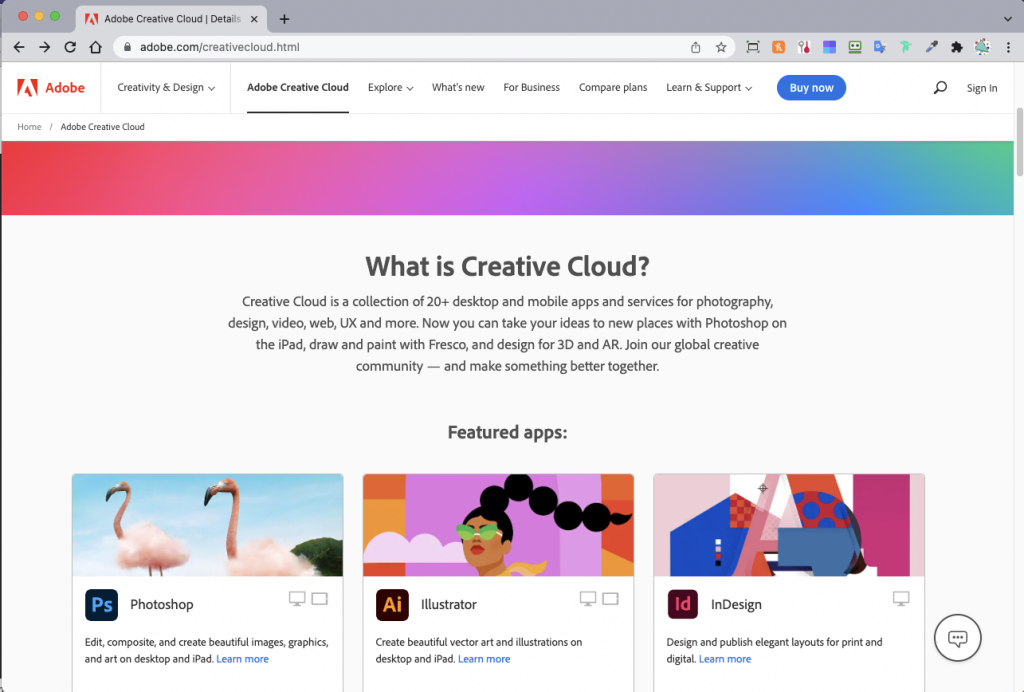
Adobe has multiple products under a single brand. Creative Cloud, their main product line, includes Adobe Acrobat, Adobe Acrobat Reader, Adobe Photoshop, Adobe Illustrator, Adobe Lightroom, and more. Adobe markets Creative Cloud to very different audiences, and allows individual users and teams to select the apps that best meet their graphic design, photography, and other creative needs.
Adobe Creative Cloud includes over 20 desktop and mobile apps
In closing, if your organization manages several brands, make sure that you have a clear strategy. And make sure to document this strategy and also provide clear brand guidelines so you can communicate consistently and clearly with your target audience.
A couple of weeks ago, a client selected my design firm to help with getting their brand on merchandise to sell at events and in their online store. I asked if they had their brand in various layouts and file formats for digital and print purposes. If the answer was, “Yes,” they were ready to go.
It turns out that what they really wanted was a new or refreshed brand, as they felt the current one was outdated.
If you want a new or refreshed brand, find answers to the following eleven questions before you speak with your graphic designer.
Great Explorations | Original Brand
Arm yourself with plenty of information before you start the design process. If you don’t know where to start, seek advice from a graphic designer in knowledgeable in design, business and marketing issues and trends.
1. What are your business goals?
Believe it or not, a brand is more than a logo or graphic design; it is about your organization’s message, and how you communicate that message verbally and visually. So, it follows that business goals are connected to your brand. What is your organization’s “big picture?” Are you expanding into new markets? Are you planning new products, services, locations, or methods of reaching out to current or prospective clients?
2. What do you want this Brand to accomplish?
Think about how the graphic design of your brand fits into your marketing plans. If you have an established brand, you might want to update it to capture new markets. If you plan to launch a new brand, how will you generate brand awareness in the marketplace?
3. Who is your target audience?
Do/will you use digital marketing–social media, email, blogs to communicate with current and prospective clients– or traditional print, TV, radio and merchandise marketing methods? Where and how will you display your brand?
4. What marketing channels will you use?
Lorem ipsum dolor sit amet, consectetur adipiscing elit. Ut elit tellus, luctus nec ullamcorper mattis, pulvinar dapibus leo.
5. How Do you want your brand perceived?
What 3-5 adjectives describe your brand’s personality? For example, “youthful, urban, and edgy,” “corporate, seasoned, and traditional,” or something else? Do you see your brand as casual or formal; modern or traditional? Where do you see your product or service positioned in the market?
6. What are your brand/company values and mission?
If you closely tie your business model to your values and mission, then your brand design may reflect them. A preschool might want to incorporate a school or students. An environmental organization might want to use a tree, a leaf, something green, or something related to the earth.
7. Do you want to avoid certain topics, themes, imagery or colors?
Images and colors mean different things in different cultures. You may think that all firms that cater to your target audience have brands with similar elements, and you want your brand to stand out. Or, you simply might not like the color orange or purple.
8. Who are your key competitors?
What do you like or dislike about your competitors’ brands? Your graphic designer should create a brand that stands out from the competition, at the same time keeping in mind that you are going after the same audience.
9. Which existing brands do you admire or want to emulate?
If you are a tech startup, do you admire the designs of Apple, Dell, or Microsoft?All of these are quite different, yet recognizable worldwide–and each has gone through a transformation over the decades. What do you specifically like about the brands you admire?
10. What do you like and dislike about your current brand?
Knowing what you like and dislike is valuable information that will help you to launch your new or refreshed brand. You may think the colors or typeface are outdated, or you may think you want to start over with a new design. Either way, this is a great opportunity to enhance your overall brand strategy.
11. What is your decision making style?
When you embark on a branding initiative, your graphic designer will ask you to make a series of decisions, from design choices like brand style, images, color and typography (fonts) to technical choices like file formats, resolution, and the size your brand will be displayed. Where you are on the scale from Decisive to Indecisive will impact your ability to meet project objectives, scope, schedule, budget, and timeline.
Do you make decisions quickly? Do you make decisions based on feelings or facts? Do you get bogged down in “analysis paralysis?” For a description of business decision making types, read more here.
When I say, “You,” I really mean “you and your key stakeholders in this branding effort.” I recommend that you seek input from your key stakeholders before reaching key project milestones, but I do not recommend building your brand “by committee.”
The Justice Hub School | Original Brand
Spending time to answer these eleven questions–including input from key stakeholders–can better position you for success in your branding initiative. Credit to 99 Designs for their original post; I added my perspective to their eleven questions.
Is all this effort worth it? Clients who understand the importance of branding say it is. If branding is new to you, So You Think You Need a New Brand might provide some insight.
As always, if you lack the internal resources to do a branding project, seek outside help. And, if you don’t know where to start, seek advice from a graphic design professional that also understands business and marketing issues. You will be glad you did.
Creating a new or updated website to reflect your organization’s identity takes a bit of thought and planning.
Your website is an important part of your organization’s identity. A well-designed website reflects well on your organization, and a poorly-designed website can damage your reputation. I know this is hard, but spend time planning your website before you build it. Understand your audience and design your site accordingly. Make the site attractive and easy to navigate.
Whether you plan to redesign your website or are in the enviable position of designing a new website from scratch, take the time to find answers to the following questions to set your website project up for success. You will be glad you did!
Purpose
WHO is your target audience?
HOW will your website serve that audience?
WHAT is the compelling marketing message that is tailored to your audience?
WHAT problem does your website solve for each type of person in your audience?
WHAT is the site’s purpose, such as informational, e-commerce, blog, portfolio, news, or a combination of several purposes?
Content
What is the clearly defined goal for each page on your website?
Is your Home/Welcome page compelling?
Does your About page describe the problems that you solve in simple and easy-to-understand terms?
Is your web copy geared to your target audience, clear, easy to understand, and free of jargon?
Do you have a landing page that you can use to collect email addresses and create email subscriptions?
Do you have effective Calls to Action that lead your visitors to a desired action?
What legal content do you need, such as Terms of Use, Privacy, Copyright, and/or other statements?
Design
Is your website “look and feel” cohesive, and consistent with your company’s branding and color standards?
Is your website’s navigation clear and easy to use?
Is the site typography easy to read (fonts, type size, type hierarchy, headings, color and contrast)?
Do you use high quality graphics and images on your website?
Do your fonts and images load quickly?
What is your preferred technical platform, e.g., as HTML + CSS, or a Content Management System like WordPress, Wix, or other?
Is your website responsive—readable on mobile, tablet, laptop, and large screen devices?
Can you maintain and update your website in-house, or do you need an outside specialist?
Marketing Goals and Objectives
What business results you expect from your website?
How do you plan to drive traffic and visitors to your website?
What system do you have in place to track visitor behavior and interactions on your site?
How will your organization generate and capture website leads?
Are your site and any blog posts optimized for search engines?
Security and Backups
What systems will be in place to protect your site from hackers?
What tools or systems are needed to address website crashes and spam?
What user and password security measures will your site have?
What is your backup and recovery plan, including on-site and offsite storage?
What is your periodic site audit plan?
Granted, 30 questions is a lot to answer—but take the time to find answers to every question if you want a website that addresses the needs of your audience and yields business results. If you are not sure how to proceed with your website design and build, please consult a professional that understands the technical, marketing, and business aspects of website creation. You will be glad you did!
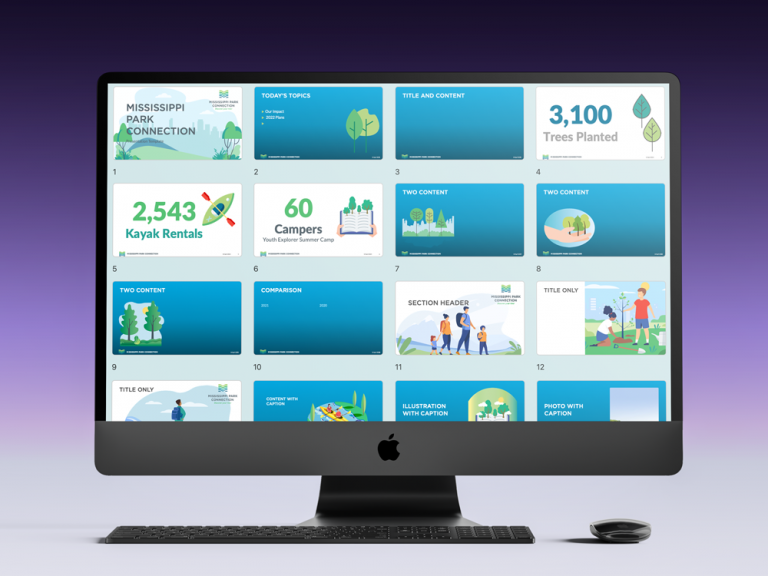
Custom, branded presentation template for Mississippi Park Connection
Mississippi Park Connection needed a custom, branded presentation template to convey its mission and message. They selected Jill B Gilbert to design the template. “The challenge was to understand Mississippi Park Connection’s needs, and find a style to complement the organization’s three pillars—habitat restoration and tree planting; paddling the Mississippi River; and youth education,” says Gilbert. MPC is thrilled with the presentation template, which includes over twenty customized illustrations that will appeal to diverse audiences, from prospective board members to volunteers and Park visitors of all ages. Read more about the project here.
“Jill was wonderful to work with. She responded positively to our initial feedback on a design and came back with an update that accurately met our needs and vision while incorporating her professional expertise in PowerPoint and graphic design. She is prompt, communicates efficiently, and pushed the project along at times when I felt overwhelmed. We now have a well designed, branded, and functional PowerPoint presentation that will bring cohesiveness to all our presentations. Thank you Jill!”
–Callie Sacarelos, Communications and Marketing Manager, Mississippi Park Connection
Mississippi Park Connection is the nonprofit partner of the Mississippi National River and Recreation Area (U.S. National Park) and has headquarters in St. Paul, Minnesota, at the start of the river.
Jill B Gilbert is a graphic and web designer with years of experience creating impactful marketing communications for both digital and print platforms, for large corporations, small businesses, and non-profit organizations.
the nonprofit partner of Mississippi National River and Recreation Area
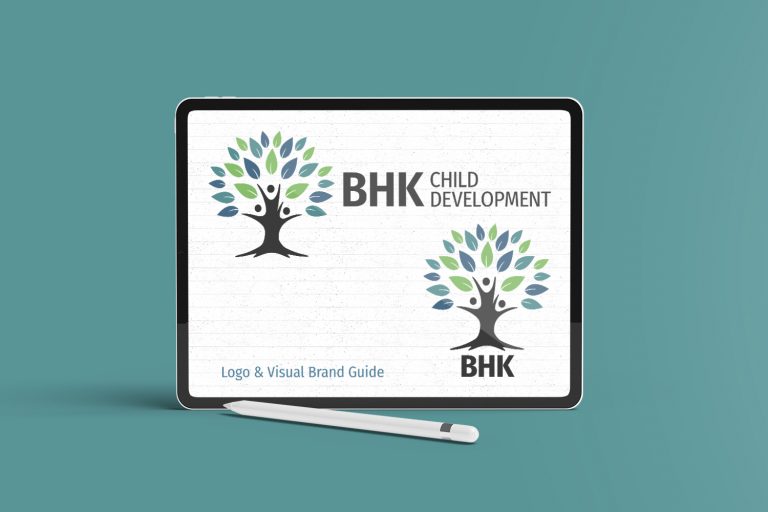
Jill B Gilbert is pleased to be selected to refresh the logo and create a visual brand guide for BHK Child Development, Inc. This early childhood care and education non-profit serves three rural counties in the Upper Peninsula of Michigan.
The new BHK logo incorporates a tree to symbolize children and growth and to reflect the natural surroundings in which many of the non-profit’s programs take place. The new color palette includes soothing blues and greens with dark gray.
Working with Jill on our visual brand guide was our first Catchafire project and it was a great experience. Jill's expertise, feedback, and consistent communication resulted in a product that we are very pleased with and excited to put into use.
Cheryl Mills
Executive Director, BHK Child Development Board, Inc.
Working with BHK Child Development was one of my first “fully remote” graphic design projects. Once I determined their needs and provided design concepts, they were responsive and provided clear and open feedback. I was happy to deliver a refreshed logo and a brand guide that will take their organization into the future. I enjoyed working with Cheryl and Marcy.
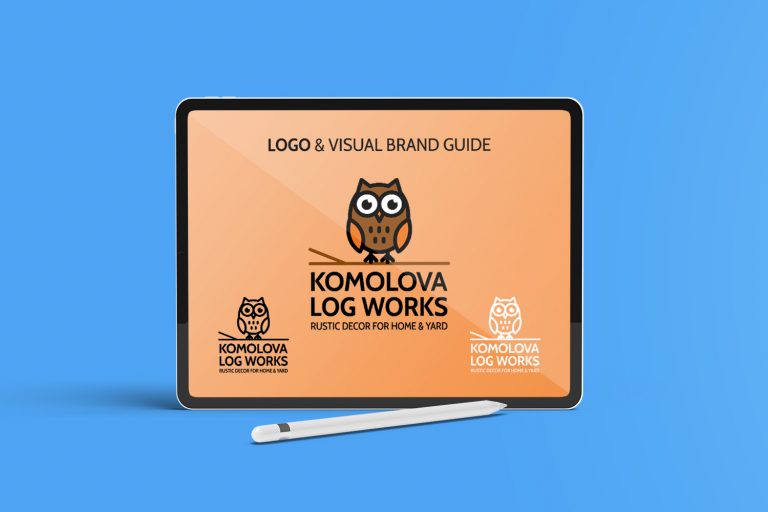
When Eric and Nancy Raup needed a brand for Eric’s craft furniture and decor business, they immediately thought of Jill B Gilbert.
After identifying Komolova Log Works’ needs, Jill created three design concepts. After further discussions and iterations, Komolova revealed that they wanted to include an owl.
Here is the result—a playful owl standing on a tree branch. The logo, tag line, and color palette work together to communicate the brand, as well as the rustic setting for the business.